
 NEW YORK (WOMENSENEWS)–This Christmas, Maria Lucia marks the 20th year of celebrating the holidays far from many members of her family.
The street vendor in East Harlem has lived in the United States since 1990 but does not have the proper papers to visit Mexico, where much of her extended family lives.
She lives here, with her two children, in an enclave of Manhattan where most of her fellow vendors also are women.
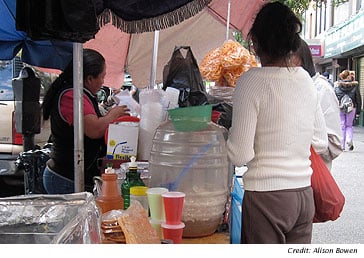
Lucia tends her cart on a stretch of Spanish Harlem along with a dozen or so other women who also sell homemade Mexican breakfast and lunch.
Spooning a chunk of rice into a tortilla, Lucia, a petite woman who wears two layered black fleece jackets to battle the chilly air, adds a scoop of seasoned chorizo before carefully folding the bulky gordita into foil.
Since the arrival of cold weather, Lucia has been serving familiar Mexican comfort food for the winter: arroz con leche, or warm rice with milk, and hot tamales.
For Lucia, vending is a better job than the factory where she spent 10 years making clothes. It’s also less demanding than the time she spent in Mexico cultivating flowers.
"It’s much easier," she says in Spanish.
"Vendedoras," or female street vendors, are the vending majority here, so much so that in 2003 they started a group to support each other called Esperanza del Barrio, or Hope of the Neighborhood.
The group helps vendors, many whom do not have proper paperwork, pay taxes in the United States, avoid fines and handle questions by the police.
Vending often attracts undocumented immigrants because it’s one of the few jobs not requiring a Social Security card.
Like many advocacy groups, Esperanza also works to help its members understand immigration law, boiling down complexities and explaining how individuals can remain in the United States, often with families they’ve raised here.
A Group Formed by Women
A few other groups help street vendors, but Esperanza is unique because of its formation by women, most of them Latina immigrants. Today, about 60 percent of the 125 vendors registered with Esperanza are women.
"I think it’s just seen as a woman’s thing to do," said Peter De Vries, director of Esperanza. "The guys go to construction, and the girls go into street vending."
De Vries says a vendor’s income can vary widely. Women such as Lucia, who help with a cart they don’t own, can make $50 a day, "perhaps more, perhaps less." He added that factors like the weather, the police and fines can also make a difference in take-home pay.
Immigrant workers have suffered diminished rights under U.S. employment and labor laws, according to a November report produced by the Los Angeles-based National Immigration Law Center. The report indicated that immigrants, 16 percent of the non-farm work force, are often employed in dangerous sectors such as construction, meatpacking and poultry industries.
In the hopes that comprehensive immigration reform will be debated within Congress in 2010, the National Immigration Law Center says legalizing undocumented workers would improve key working conditions.
It also says immigration status should not be shared with federal investigators and workers should not be discriminated against because of their immigration status.
Female vendors formed Esperanza after a number of women encountered problems with authorities. Some were being overwhelmed with fines for operating without a license and losing food to the trash if they couldn’t produce proper paperwork.
Maria Yascaribay, who sets up her meat cart about 20 feet away from Lucia, remembers those days well. When she started vending here 12 years ago, the problems with the police were persistent, she says.
Fewer Police Hassles
After the vendedoras created Esperanza, she says in Spanish, "The police don’t bother us much."
De Vries, a former Phoenix public defender born in Guatemala, says that since he’s taken over as Esperanza’s director this year, complaints about the police have ebbed. He leans back in his chair in the tiny office near 117th street. It’s cluttered with event fliers and filing cabinets that contain manila folders for each vendor.
The folders keep track of the vendors’ tax records and other legal paperwork, piles of black-and-white forms and signatures that make up a complicated but necessary part of vending.
"We just decode the system," De Vries said. Immigrants who only speak Spanish have trouble grasping the process of filing their taxes, getting a license or paying fines that can top $1,000.
Esperanza helps them get an Employer Identification Number, which can be used to pay taxes when a worker lacks a Social Security card. The tiny staff –De Vries and a few volunteers–also helps vendors pay state sales taxes four times each year.
The group also offers its members workshops on topics such as domestic violence, women’s health and tutoring for school-age children.

Lucia, who often wears her hair gathered in a black scrunchie, lives in a nearby apartment, where she gets up at 5 a.m. to begin cooking.
Nearly everything–the gorditas, tostadas and especially the rice–must be cooked on the same day. Then she packs the food into a white minivan.
One evening, as the street is beginning to darken and a small patch of orange sky is framed by the buildings at the west end of Manhattan, Lucia is in a hurry.
Immigration Process a Maze
Esperanza is hosting a workshop at 7 p.m. with immigration lawyers. Tonight is a chance for the vendors–and anyone else who’s seen the fliers strewn on their carts–to learn how to live legally in the United States without fear of deportation and about the benefits of residency.
But the process seems like a maze, with one end point and most routes blocked.
Lucia was born in Atlixco, an agriculture city two hours from Mexico City, where her family worked in the fields harvesting onions, flowers and squash. After working in the flower fields, she came to the United States in 1990 "to have a better life," she says, shrugging.
She has a son and a daughter, who recently gave birth, who live nearby.
She still misses the hometown she can no longer visit because she lacks the required documents. To gain legal status in the United States, she would likely need to return to Mexico and try to enter legally with an approved visa.
Many immigrants like Lucia, whose children are here, fear that route will trap them in Mexico, due to years of paperwork, and keep them from seeing their children and grandchildren again.
At the workshop, two immigration lawyers take turns explaining different types of visas and how to gain residency.
One cautions the crowd to stay out of trouble with the police; good moral character is an important component to becoming a citizen, he says.
One woman, who earlier that day was in Esperanza’s office asking for help, nervously raises her hand. Will it count against her if she has been fined as a street vendor?
"Usually this doesn’t have a bad effect," the lawyer assures her.
The lawyers explain the few exceptions that would allow a worker to quickly attain the kind of legal status that would allow Lucia to travel home to Mexico.
A victim of domestic violence, for instance, might have a shot. But it’s no guarantee, and people like Lucia who lack documentation tend to stay under the radar rather than "come out of the shadows" and risk being deported.
In the church basement, the crowd of about 75 strains to hear the lawyer’s answers translated. Toddlers play under the chairs.
In the back of the room, Lucia gently pushes a stroller back and forth with one hand. It is bedtime for her infant grandson. Outside on 116th street, the carts have disappeared, fire trucks are screaming and teenagers are lingering outside the bodega next door.
In 12 hours, Lucia will be back on this street, sitting in a folding chair in front of the white van that carries the stacks of fresh gorditas and tamales, pulling out the sturdy umbrella and starting over again.
Alison Bowen is a New York City-based freelance journalist pursuing a master’s degree in journalism and Latin American and Caribbean Studies at New York University.
For more information:
Esperanza
http://www.esperanzadelbarrio.org/
StreetVendor
http://streetvendor.org/
Vamos Unidos
http://vamosunidos.org/