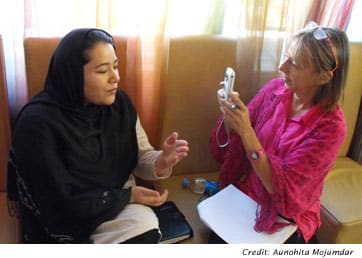
Afghanistan’s amnesty for war criminals is not playing well in a therapy theater group for Kabul women victimized by years of violence. They wait for a form of justice while perpetrators of violence get impunity and a chance to hold positions of power.
U.N. Security Council Resolution 1325 calls for women to be involved in peace talks. But Afghan women–after a series of setbacks–place little faith in that. They’re mounting their own push for inclusion at a spring meeting of national leaders.
Preliminary tallies in the Afghan election are expected Tuesday. However, women’s participation was expected to be low, as security fears and conservative customs discourage female voters, candidates and poll watchers.
A group of Afghan women are defying convention by studying and producing expressive contemporary art. Their work offers an abstract commentary on the restrictions that often govern women’s lives.
The capital of Afghanistan is a tough place to start and run a restaurant but a handful of foreign women are doing just that. For one, Kabul is the latest in a series of post-conflict cities where she has catered to the nomadic “U.N. crowd.”
Women are jailed in Afghanistan for “crimes” that would make them victims of domestic abuse elsewhere. As the annual festival of Eid brings the prospect of presidential pardons, advocates warn that many women are safer inside prison.
While Afghanistan’s Parliament offers one of the most generous spaces for women’s participation in the country’s public life, female parliamentarians are ending their first year feeling fractured and far from the start of a true women’s caucus.
Habiba Sarobi was appointed Afghanistan’s first female provincial governor last year amid media fanfare about women’s rights. Now she says nothing matters for her province or her political career except getting some paved roads.
In post-Taliban Kabul, an Italian aid agency is training women to enter fields that are dominated by men. Sixty women are now ready to start work as caterers, lantern-makers, gem-cutters and mobile phone repair technicians.
Italian journalist Giuliana Sgrena was kidnapped in Iraq only to be shot by U.S. soldiers upon her release. In September she went back to work in Afghanistan to continue her reporting on the impacts of war on everyday life, especially women.
This site uses cookies to provide you with a great user experience. By continuing to use this website, you consent to the use of cookies in accordance with our privacy policy.