
As a Swedish-American living in Stockholm, I’ve had to reckon with the changing world order posed by the Russo-Ukrainian war. The Swedish navy now encounters Russian submarines in the Baltic Sea on an “almost weekly” basis, and Russian aircraft increasingly breach NATO airspace in brazen acts of provocation—constant reminders of the conflict raging to the south and the real danger of it spilling into the Nordics.
I’m in high school, and the young people I know have been paying close attention to the constant rounds of peace negotiations between Russia, the United States, and Ukraine, even as war in Iran has erupted and spilled into our daily lives. The peace talks held in Moscow on December 2, 2025 featured no European delegation, despite the proposed plans’ reliance on Europe for the “bulk of financing and security guarantees.” A few weeks later, Ukrainian diplomats met with U.S. officials at President Trump’s Mar-a-Lago residence to discuss a potential framework to end the war. Yet again, no European representatives were invited to attend the summit.
The photos from that day in Florida show rows of tense officials, flanked by cameras and flags, gathered around a conference table. The images are striking, not only due to the absence of European representation. There’s another glaring omission: where are all the women?
I’m interested in this question not only because I am a young woman. The presence of women at every stage of conflict resolution has been proven, time and again, to produce more effective and durable outcomes. Yet it appears there was only one woman present at the Mar-a-Lago gathering: Olga Stefanishyna, the Ukrainian ambassador to the United States. I had to dig deep to find photos capturing her at the table. The ones that did mostly showed the back of her head, a representation of how little she mattered at this event (at least according to the media).
In 2000, the United Nations Security Council passed Resolution 1325, setting the target to achieve women’s “full, equal, and meaningful participation in peacemaking, peacekeeping, and peacebuilding by 2030.” But, today, we’re not even close to reaching that goal. The World Economic Forum estimates that full gender parity won’t be achieved until the year 2158. This puzzling lack of female representation is not limited to the United States. Statistics compiled by United Nations Peacekeeping reveal that in 2024, “Women made up only 7 percent of negotiators on average worldwide, and nearly nine out of ten negotiation tracks included no women negotiators at all.”
According to a 2015 review by the International Peace Institute, a nonpartisan think tank based in New York, “Women’s participation increases the probability of a peace agreement lasting at least two years by 20 percent.” A 2018 Swiss study found peace agreements where women were directly involved to be more durable and better implemented. These benefits extend beyond individual negotiators. Desirée Nilsson, Professor in Peace and Conflict Research at Uppsala University, argued years ago that “The participation of civil society groups, including women’s organizations, makes a peace agreement 64 percent less likely to fail.”
It’s disheartening that women’s participation in peacekeeping strategies is so low when the stakes are so high. Research shows that countries with greater gender equality are more likely to resolve conflicts without violence before they start. The probability of those countries using military force to settle international disputes is also reduced.
In general, women in leadership positions tend to improve their communities. Last September, a United Nations report concluded that “[w]omen’s equal participation and leadership in political and public life are essential to achieving the Sustainable Development Goals by 2030,” and recognized “established and growing evidence” that female participation in political decision-making processes improved the communities around them. To wit, the number of drinking water projects in areas in India led by women is 62 percent higher than that of projects led by men. Similarly, in Norway, the presence of women in municipal councils results in better childcare coverage.
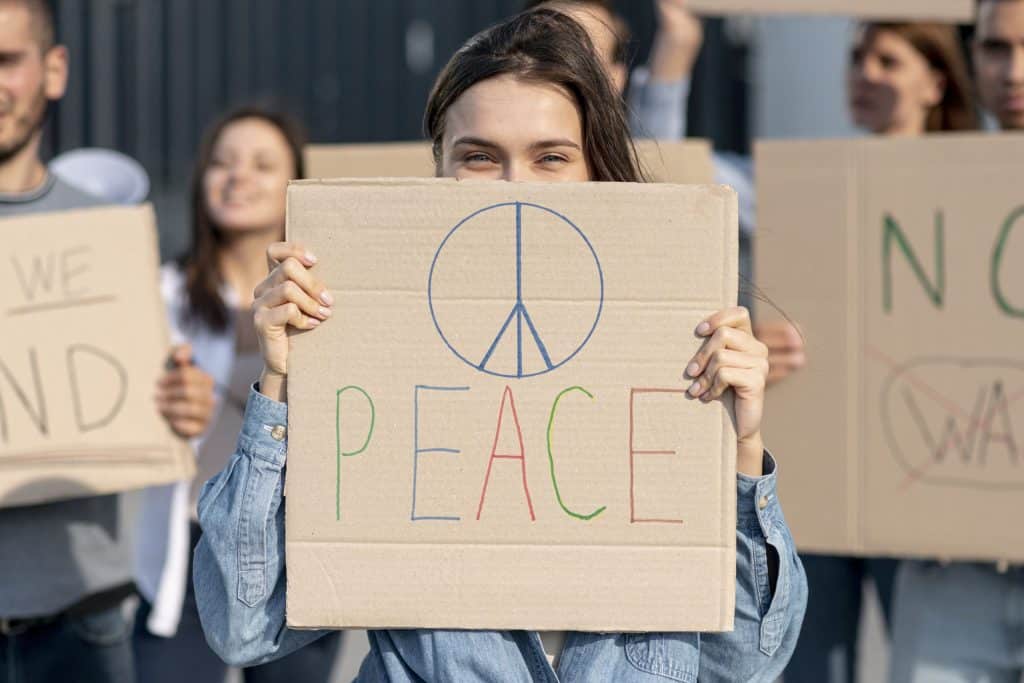
To be clear, the low representation of women in formal peace processes is not a reflection of their disinterest. Women want in; they’re often already doing the work informally. A 2020 study of informal peace efforts found that in three-quarters of cases, women’s groups were actively involved in grassroots-level peacebuilding. The explanation of why women are consistently excluded from high-stakes geopolitical negotiations points to a wide range of reasons: From systemic sexism and pay gaps to the tacitly masculine social spaces where exclusive connections are made. The problem is not that women aren’t interested or capable of doing this work. It’s exclusion, full stop.
Recent data suggests that well over 600 people die directly or indirectly from war every day. To me and my family here in Sweden, the proximity of the Russia-Ukraine conflict is a constant threat. So why isn’t everyone marshalling their best resources—their best people—to achieve peace? International policy is a reflection of society based upon how people are treated up and down the chain of command. We all need to catch up: Our leaders can’t exclude women from the negotiating table anymore.
About the Author: Annika Lubin is a sophomore at Stockholm International School in Stockholm, Sweden.


