
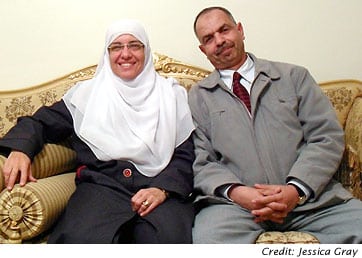
 CAIRO, Egypt (WOMENSENEWS) — Azza El Garf, a prominent figure in the Freedom and Justice Party, the political wing of the Islamist group the Muslim Brotherhood, offers a profile in political contradiction.
She shares her party’s family-first view of a woman’s place, but at the same time plays a pioneering role in the minuscule minority — just 1 percent — of women serving in the country’s post-revolution houses of parliament.
"People here think women can be a doctor, go to university, be a teacher or an engineer," El Garf said in a recent interview in Arabic conducted through a translator. "But people still think ‘women are no good at politics.’ We want to change this view."
She condemns the notorious "virginity tests" that military officers and doctors are accused of perpetrating on a group of female protesters in March 2011.
But she disagrees with Egypt’s 2008 ban on female cutting, which opponents call genital mutilation. The World Health Organization defines it as the partial or complete removal of the external female genitalia, or other injury to the female genital organs for non-medical reasons.
"It is a personal decision and each woman can decide based on her needs. If she needs it, she can go to a doctor," El Garf said, adding that the Muslim Brotherhood refers to the practice as beautification plastic surgery. She was adamant that it was a woman’s choice, and hers alone, to have the outlawed procedure and should be done in consultation with a trained medical professional.
El Garf insisted that Islamists will uphold women’s rights. But she also said divorce had become too easy. By declining to specify how that affects her legal views, the comment is likely to reinforce expectations that Islamists will seek to roll back women’s divorce rights, as Hoda Badran, chairwoman of the newly resurrected Egyptian Feminist Union, warned in a January interview with Women’s eNews.
In 2005, Egypt passed a law allowing Muslim women a no-fault divorce for which they can file in court without needing permission from their husbands or male relatives.
‘Egyptian Families Under Pressure’
"Family is the most important part of life," El Garf said. "Egyptian families are under a pressure and that can divide them. But religion connects family members and keeps them together."
She said the husband’s job was to feed his wife and care about his family because together they are one. "The woman’s job is to make him happy," she added. "In Western society everybody is an individual. That system doesn’t work here."
A mother of seven and a graduate of Cairo University with a degree in social work, El Garf has been a member of the Muslim Brotherhood for 32 years. In that time, she said, her dreams of holding political office were never stifled by her party or her religion. She said Islam, which preaches equality between the sexes as well as traditional gender roles in marriage, promotes the education of women and their place in the work force.
Her party, however, places limits on what kinds of political participation it deems acceptable for women.
Last December, while women’s rights leaders here recruited thousands to a demonstration in Cairo against sexual harassment and military violence against women, her Islamist party said the march shamed female demonstrators, who should have let husbands, brothers or fathers defend their rights.
At a March 8 gathering for her own party’s committee on women, El Garf and another female member of parliament from her party fended off suggestions by critics in the media that women have no real role in the People’s Assembly due to their small number. The lower house currently has eleven female members, the upper house has five. Together they make up about 1 percent of the combined houses. Just six women have been nominated for the 100-member constitution drafting committee.
‘Quotas for Regime Puppets’
El Garf said that reserving seats for women — instituted in the 2010 parliament elections and then annulled — amounted to "decoration" because they were reserved for "regime puppets" chosen by Mubarak’s National Democratic Party.
Egypt’s 16 female parliamentarians, she said, have legitimacy that many of the women in the last parliament did not because they were chosen by "the people." She expressed confidence that women’s numbers in parliament will grow as Egyptians see more and more capable women taking active roles in politics and in their communities.
Eric Trager, an American fellow at the Washington Institute for Near East Policy, said that women have little sway in El Garf’s political contingent. "The Muslim Brotherhood is a mostly male-dominated organization where all of the key decisions are made by bodies that are entirely comprised by men," he said. "The Muslim ‘Sisters’ … they are not involved in the decision-making processes."
Trager is careful to avoid lumping the Muslim Brotherhood together with fundamentalist Salafists from the Al Nour Party, who refused to put pictures of female candidates running for office on their posters. "One of the differences is that women are allowed to have a public role for the Brotherhood. You did have some serious female Brotherhood candidates; you had women’s faces appearing on campaign posters, whereas that was not the case for the Salafists."
But he predicted that the Muslim Brotherhood would not help women’s rights take center stage or do much to expand women’s ranks in politics, business or religious councils.
"You can see the Brotherhood’s conservatism on these kinds of social issues with how they’re responding to the National Women’s Council," he said. "They don’t want a National Women’s Council, they want a National Family Council. I think in these kinds of ways they’re going to make women’s issues more akin to family issues, which says they have a more conservative perception than we have in America."
Muslim Brotherhood members have angrily opposed plans to resurrect the National Women’s Council, previously led by former First Lady Suzanne Mubarak. The council was shut down after a fire ripped through its offices last year and was often criticized by human rights activists as political window dressing.
The Freedom and Justice Party, by contrast, saw it as a potent threat to family life and another arm of the overthrown regime.
El Garf stands with her party on this. She said a state-backed family council would serve Egyptian women better than a women’s council.
She also said she supported a diversity of non-profit or non-governmental groups to advocate for women’s rights and to promote education, as long as groups are backed by Egyptian donors and funds alone.
Would you like to Comment but not sure how? Visit our help page at https://womensenews.org/help-making-comments-womens-enews-stories.
Would you like to Send Along a Link of This Story?
https://womensenews.org/story/genital-mutilation/120327/islamist-parliamentarian-objects-egypts-ban-fgm
Jessica Gray is a Canadian journalist reporting on the Middle East from Cairo.