
Recently, the conservative American Enterprise Institute announced the virtual death of the gender gap in wages–citing entry-level figures. At that level, women make 98 percent of what men do. But the institute failed to announce that it was only comparing the salaries of young workers.
Moreover, new research indicates that another ominous crevice may be opening.
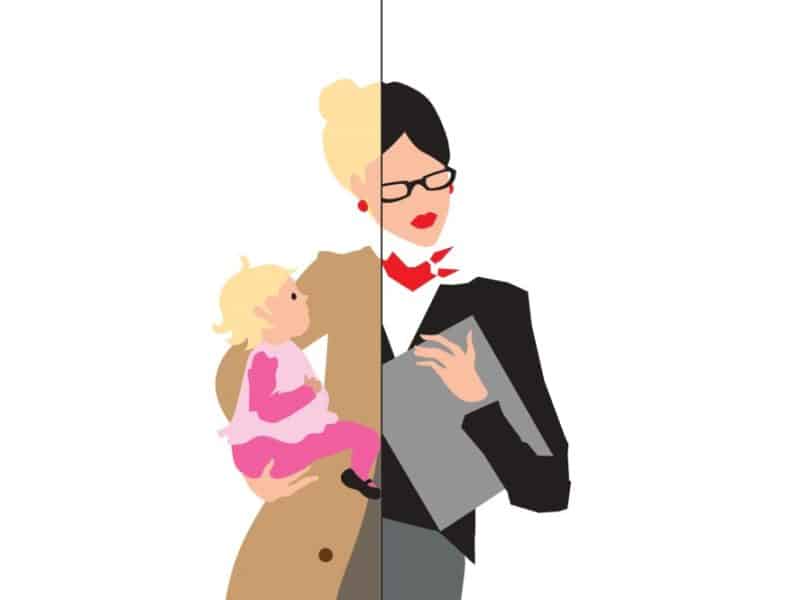
The "mommy gap."
Today, the gap in hourly wages between women with and without children is greater than the gap between men and women.
While the hourly wages of women without children are roughly 90 percent of men’s hourly wages, the comparable figure for women with children is 70 percent.
When hourly wages of new employees are compared, the gender gap is very narrow. But by the age when most women begin having children, the birth of these kids penalizes women by roughly 20 percent. Among mothers, those who have more than one child, or who are black, or single, pay an even larger family penalty than married white women with only one child.
This mommy gap has come to light through new, sophisticated research on the gender gap, including the work of Jane Waldfogel at Columbia University.
This new gender gap in wages takes a huge toll on American families. Noted economist Heidi Hartmann and her colleagues report that American families lose a staggering $200 billion annually to the wage gap–an average loss of more than $4,000 each for working women’s families every year.
This mommy gap is going to affect a huge number of women, researchers note.
For example, as of 1996, 56.6 percent of all children had mothers in the labor force, as did 68.4 percent of children 6 through 17. For the latter group, 75 percent of mothers are working full time. The overwhelming majority of women with kids of all ages are working full time.
And while we as a society give lip service to support for working families, the true picture is grim.
A new study of 11,815 managers by researchers at the City University of New York found that leaves of absence were associated with fewer promotions and smaller salary increases. And since 89 percent of the managers taking leaves were women, there is a consistent pattern of women slipping further behind.
For those who argue that women belong at home, while men do the breadwinning, the trends in men’s employment are not encouraging.
Men’s wages have been stagnant or declining for two decades, and the life-long, well-paid industrial job that was so common 30 years ago is rapidly vanishing. And since more companies than ever before are down-sizing (615,000 pink slips in l998, more than the previous high in 1993), families that depend on one income could fall into financial chaos.
New figures on longevity illustrate how the gap will affect women in the long term.
The National Center for Health Statistics says that the life expectancy of the average woman at birth today is eighty years. That number is expected to jump to 83 for babies born in the year 2010. (Some demographers have even estimated that one in three white baby girls born today will live for a century.) And for women who survive to age 65, the chances are that they will live for another 19.5 years.
But it’s going to be hard for them to support themselves for such a long life. Mothers, it turns out, are the big losers in the workplace and the most at risk as they age. And there’s going to be a lot of them. By 2050, the population of persons 60 or over in the world will have more than doubled, exceeding the proportion of children under l5.
But the mommy gap is not inevitable. In countries such as Sweden and the other Scandinavian countries that have job protection legislation, paid maternity leave and policies promoting flexible work hours, there is no such gap; in countries such as ours, where such job protection legislation is minimal, the gap is relatively large.
The demographics alone argue that it’s of the utmost importance to close the gap, to expand maternity and paternity leaves, initiate job protection policies, expand good, affordable child care, institute more family-friendly policies and to use tax policy and private-public partnerships to support today’s dominant family form: the dual-earner couple.
The alternative could be an army of women who have outlived their financial resources and must either be left to fend for themselves or be supported by public charity. Neither of the latter scenarios seems to make economic sense.
Rosalind Chait Barnett of Harvard and Brandeis and Caryl Rivers of Boston University are the authors of "She Works, He Works," (Harvard University Press.) They are at work on a new book on the future of the sexes.