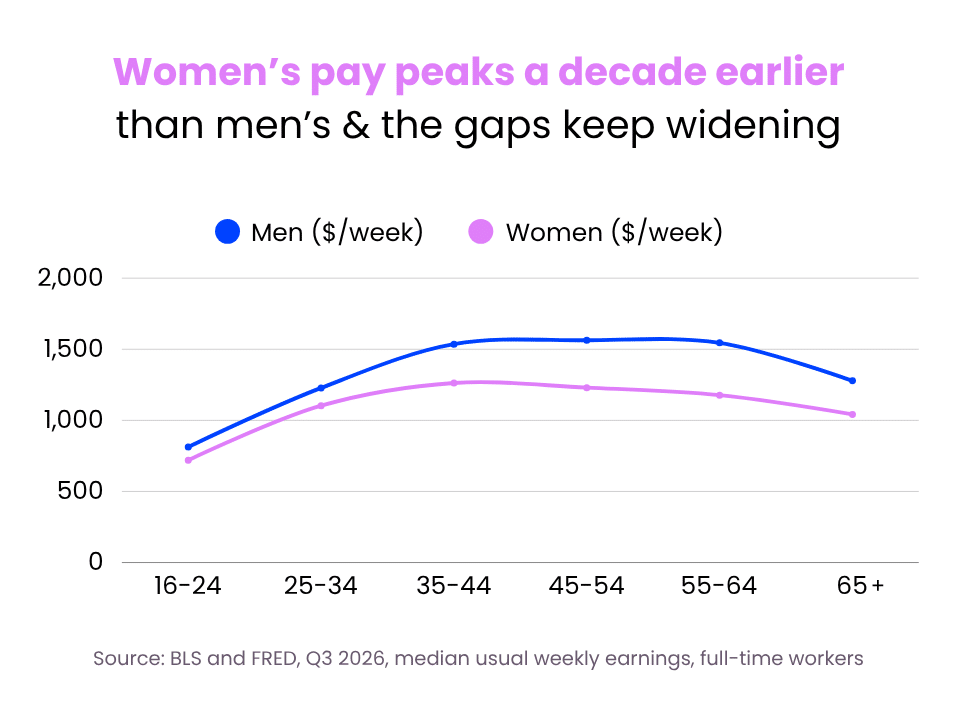
A woman aged 55-64, with decades of experience behind her, earns $51 a week less than a man aged 25-34. So where does the gap between men’s and women’s pay open and what does it cost?
Zenius analyzed Q3 2026 Bureau of Labor Statistics (BLS) median weekly earnings for full-time US workers by age and sex to find out. The answer is that it opens in a single decade and adds up to an estimated $571,480 over a 40-year career.
In their late twenties, women come closest to parity
The typical woman earns 89.8¢ for every $1 a man earns at 25-34 years. In annual terms, that is a gap of $6,500. This is the closest the two genders get at any age.
Early-career pay is largely determined by entry-level pay bands and market rates for a role. This leaves little room for a gap to open.
Interestingly, women’s pay actually grew slightly faster than men’s between 16-24 and 25-34.
The paths split in their thirties
In the space of one decade, the annual gap more than doubles to $14,196. Women’s pay falls to 82.2¢ per $1 at the same time.
This is mainly because women’s median pay rises 14.5% between the two age bands, while men’s rises 25.1%.
The timing is hard to ignore. A Rice University study found that over 30 years, women who delayed motherhood earned $495,000-556,000 more than those who became mothers early in their careers. This was even after considering the number of hours worked and education levels.
Researchers suggested this was due to disruption in career continuity. Women get fewer chances to advance and they also accumulate experience slower in the years when pay usually grows fastest.
Raises are an important share of employees’ existing pay. So a missed promotion or a smaller raise at 32 years can compound into a much bigger dollar difference by the time the individual turns 42.
“This will be missed by employers only auditing starting salaries. The gap opens up in how pay grows after the first decade of work,” explains Rohit Agarwal, co-founder of Zenius. “Employers should look at who gets promotions and raises at 30-40 years because that is where the real damage is done.”
Women’s pay stalls in the 40-50s while men’s keeps climbing
Women’s median pay peaks at 35-44 ($1,263 a week) and then slips 2.6% at 45-54. Men’s pay keeps rising to a peak of $1,563 at 45-54. Extra years of experience stop translating into higher pay a decade earlier for women.
A person’s pension contributions and retirement savings are based on their salary. So women get less time to make up for the gap they face in their final working decades.
By the end of a career, the bill comes due
The gap is widest at 55-64, where women earn 76.2¢ for every $1 men earn and lose $19,136 a year. That is 63.6% more than the all-ages gap of $11,700.
Another way to see it is in time. The 76.2¢ is equivalent to working 12.4 weeks, nearly a quarter of the year, “for free” compared with men.
The analysis’s Equal Pay Day looks at how many extra days a woman would need to work after the year ends to earn what a man in her age band earned during it. This is different from the official National Equal Pay Day.
According to this, women aged 55-64 need 114 extra days, which takes the Equal Pay Day to 25th April for them.
| Age | Annual Gap | Cents per $1 | Weeks worked “free” | Equal Pay Day |
| 16-24 | $4,836 | 88.6¢ | 5.9 | Feb 17 |
| 25-34 | $6,500 | 89.8¢ | 5.3 | Feb 11 |
| 35-44 | $14,196 | 82.2¢ | 9.2 | Mar 21 |
| 45-54 | $17,316 | 78.7¢ | 11.1 | Apr 10 |
| 55-64 | $19,136 | 76.2¢ | 12.4 | Apr 25 |
| 65+ | $12,272 | 81.5¢ | 9.6 | Mar 25 |
| All ages | $11,700 | 83.4¢ | 8.7 | Mar 15 |
Adding these annual gaps together shows the cost over a career. This was calculated by multiplying the gap by ten years per age band. The result was $571,480 for 40 years or about $14,287 a year on average.
Most of this gap accumulates later in the career: 88.6% of the total comes after the age of 35.
These figures apply today’s pay levels for a whole career and don’t consider inflation, pay rises and investment returns. So the real cost could differ.
“It is easy to miss the cost early in a career because it is back-loaded,” added Agarwal. “By the time it is obvious in a woman’s pay, it has already been building for years. So pay reviews at 35 years are far more useful than pay reviews at 55.”
This gap points employers to that first decade in employees’ mid-career time.
So the answer to the opening question is that the gap opens in the thirties and is paid for in the sixties.
Methodology
Zenius analyzed Q3 2026 median usual weekly earnings of full-time US wage and salary workers by age and sex, not seasonally adjusted. Ages 25-34 to 65+ come from the BLS age table and ages 16-24 from FRED release 332.
The annual gap is calculated as (men’s − women’s weekly median) × 52 and cents per $1 is women’s ÷ men’s median. Weeks worked “for free” is (1 − that ratio) × 52.
The gap multiple is a band’s annual gap ÷ the gap in 25-34 age band. Earnings growth is the percentage change in each gender’s median between consecutive bands, and each gender’s earnings peak is its highest-paid band.
Zenius’s Equal Pay Day is 1 January + 365 × (1 − ratio) ÷ ratio days, not the official National Equal Pay Day. The career cost sums each band’s annual gap × 10 years for 25-34 to 55-64 (40 years), and each band’s share is its cost ÷ $571,480. All calculations use unrounded values.
Rice University’s news release is used as a secondary source to add context.
Limitations
The study looks at cross-sectional data. This means that each age band contains different workers rather than one group that is tracked over time.
The career cost is a static Q2 2026 estimate that doesn’t consider inflation, wage growth, career breaks or part-time work.
The figures also don’t capture women who have left or reduced paid work as the medians cover full-time workers only.
The analysis also doesn’t control for occupation, hours, education or caregiving.
About the Author: Rohit Agarwal is the co-founder of Zenius, a remote staffing company. With his background in the hiring industry, he helps businesses build talented remote teams and scale faster than their competitors. Beyond recruitment, he has a decade’s worth of experience in content marketing and link building.