
In June, Melinda French Gates committed $215 million to menopause and midlife care. Menopause has become fundable partly because its costs finally got quantified: a 2023 Mayo Clinic Proceedings study put a number on what had long been anecdotal — $1.8 billion in annual lost workplace productivity, rising to $26.6 billion including medical costs. Even that figure counts only formal employment, not the unpaid caregiving labor where the cost is highest and least measured.
Measuring what matters is a political act. Who we count shapes who counts.
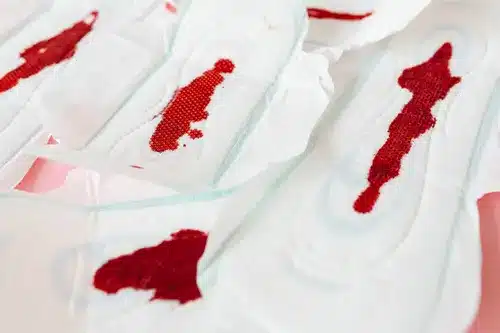
That is a lesson we have failed to apply to period poverty, the chapter of a woman’s life that precedes menopause by three decades.
What We Are Failing to Count
We measure menstrual health almost entirely in missed school days — a real cost, and a small fraction of the actual one. Period poverty compounds across a woman’s life.
No product, or an unsafe one, leads to reproductive tract infection. Left untreated, that can
progress to pelvic inflammatory disease, and in some cases infertility — an unaffordable pad becomes a fertility diagnosis a decade later. Improvised products can cause toxic shock syndrome, sometimes ending in emergency hysterectomy; the alternative is death from sepsis.
Two-thirds of low-income women struggle to access products and a place to wash; unhoused women often make pads from rags and toilet paper. Only 24 states guarantee incarcerated women free products.
None of this appears in the statistics we cite as “period poverty.” It is filed as a school absence, a prison record, a shelter intake note, an emergency room chart — four separate problems instead of one continuous one.
For women who don’t lose fertility this way, the exposure doesn’t end there. A six-continent systematic review found lower education and occupation associated with measurably earlier natural menopause. Domestically, the largest U.S. menopause cohort, SWAN, found Black women reach natural menopause roughly 8.5 months earlier than white women, with Hispanic women showing a similar pattern — linked to cumulative socioeconomic strain and, increasingly, discrimination itself. The same strain that predicts earlier onset also predicts harsher symptoms once perimenopause begins, and earlier menopause carries elevated lifetime risk of cardiovascular disease, stroke, and osteoporosis, with each earlier year linked to higher all-cause mortality. The perimenopause we are spending $215 million to understand is, in many cases, the compounding interest on a debt that began at puberty.
Capital follows evidence, so an evidence gap becomes a funding gap, and the funding gap preserves the evidence gap. It has been a closed loop for forty years.
Peri/menopausal care has to begin with menstrual equity — the products, education, and clinical attention a girl should have received at puberty, so the woman at forty-five is not relearning her own body from zero.
The Policies That Need to Change
Neither menstrual nor menopausal health has a federal floor, so both are governed by an inconsistent patchwork of state law. The Menstrual Equity for All Act and the STAMP Act — which would end remaining state sales taxes on period products and mandate access in schools, shelters, and prisons — have been reintroduced in Congress since 2017 and passed neither. Thirty-two states have removed sales tax on period products; eighteen still tax them as non-essential. Menopause fares no better federally: no law recognizes it as a protected category under Title VII, the ADA, or the FMLA, which is why Rhode Island invented its own category in 2025, and why hormone-therapy coverage still depends on the state a woman lives in.
Where laws exist, they are frequently unfunded on both sides. California requires schools to stock free products but routes reimbursement through a state-mandated-cost process — schools comply first, get paid later, if at all, which is why dispensers are so often empty. Rhode Island’s employer-accommodation law places the full compliance cost on employers, with no public funding attached. A right is declared, and the bill is handed to whoever is standing closest — the school district, the employer, the girl, the woman.
The fix is not complicated: pass what has already been drafted, fund mandates when they are written rather than after, and build the same federal floor for menstrual products that women deserve for hormone therapy decades later.
The Products That Need to Change
Access is only half the problem; safety and design are the other half. The dominant corporate response has been donation — Always alone has distributed more than 235 million period products since 2018, leaving the underlying infrastructure untouched. P&G’s own messaging concedes donation cannot resolve a systemic problem. Largely absent: product safety standards, affordable diagnostic and hormone-testing tools where symptoms first appear, and curricula treating cycle literacy as ongoing education. Menopause’s corporate posture, by contrast, has moved into real infrastructure — benefits redesign, manager training, accommodation policy — categories menstrual health has never received.
The Philanthropy That Needs to Change
The $215 million did not take menopause from zero to funded overnight — it was already visible to capital, just not philanthropic capital. NIH funded menopause research at $30–55 million a year for most of 2007–2024, roughly $617 million total, formally naming it a research category in 2023. Venture investors moved faster: menopause startups raised $230 million in equity in 2023 alone, over a third of women’s health venture dollars that year. Small foundation grants had begun arriving. What menopause lacked, as recently as January 2025, was a philanthropic actor naming it a defined category — neither Wellcome nor the Gates Foundation could tell reporters the extent of their own menopause giving, because no category existed. Ms. French Gates did not create this field; she funded one already in motion.
Period poverty has never reached that threshold in any of the three channels — no federal research category, no comparable venture market, no foundation naming it a priority. PERIOD., founded by two high schoolers in 2014, has served roughly 510,000 people to date — a fraction of one nine-figure grant’s reach in a single cycle. The fix mirrors what preceded menopause’s moment: a federal category, a philanthropic actor naming the priority, and eventually a capital market willing to follow.
Women are about to control the largest pool of private capital in history. Organizations serving women and girls get two cents of every charitable dollar. Only one of those facts is going to stay true. The largest investing opportunity for the foreseeable decade is not a fund. It is a population.
Why Earlier Matters
The through-line across policy, product, and philanthropy is the same: a woman’s hormonal life is one continuous arc, not two disconnected news cycles. A girl whose menstrual health is never taken seriously at puberty does not arrive at forty-five with a clean slate — she arrives with unexamined symptoms, an undiagnosed cycle, and no established clinical baseline. “Earlier” has to mean menstrual equity, funded and federal — not menopause research moved up a decade.
We should not have had to prove menstruation and menopause were forms of discrimination before anyone would fund them like healthcare. Every major gain to date — the tampon tax repeals, the Rhode Island law — was won in court or a civil rights statute, not a health budget. That is a signal, not a coincidence: when a body’s needs are met through discrimination law rather than medicine, the establishment still has not agreed the need is real. Funding menopause while leaving its first chapter uncounted just moves the unfunded mandate a few decades down the same woman’s life.
Dr. Vandana Arcot is a physician and global public health strategist with two decades of experience across global health agencies and states. She is the founder of Komselj, a philanthropic strategy consultancy advising donors and foundations on equity-driven giving in global health and women’s economic empowerment.