
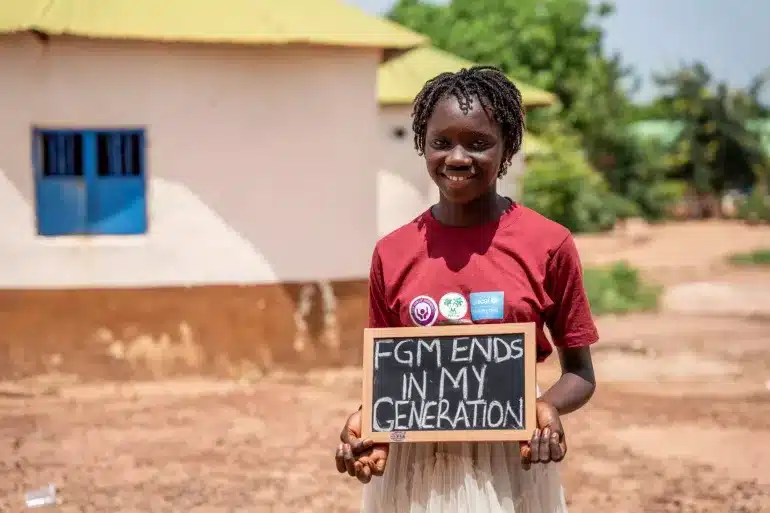
Within the next few months, The Gambian Supreme Court will make a ruling with far reaching consequences. At stake is a fundamental question: Do universal human rights apply to girls even when tradition is invoked to deny them? Once again, the ban on female genital mutilation (FGM) in The Gambia is under direct legal attack. Despite the high resistance the law is facing today, I am reminded of a moment years ago when a mother quietly pulled me aside after a community dialogue and whispered, “If this law did not exist, my daughter would already have been cut.” That moment captured what this struggle has always been about: Not abstract debates, but real girls whose bodies and futures depend on legal protection.
The Gambia ranks among ten countries with the highest rates of FGM. According to UNICEF, 73 percent of Gambian women and girls aged 15 to 19 have undergone the life-threatening practice. (UNICEF) This is an alarming figure for a country where the harmful traditional practice is currently banned. It is frightening to consider how much higher the number could rise should the law be repealed. FGM was outlawed in The Gambia in 2015 yet, despite this, the law has remained poorly enforced and the practice continues. This moment reflects a broader global pattern. Gains in women’s rights are increasingly met with organized backlash, often framed as a defense of culture or tradition. When that framing succeeds, violence is normalized and protections for women and girls become negotiable.
As a longtime activist in the fight to end FGM, I know how hard-won these gains have been and how much is now at risk. The current appeal, brought by religious traditionalists, seeks to reopen a debate that should have been settled long ago. As the world marked the International Day of Zero Tolerance for FGM[LS1] on Feburary 6, this case serves as a stark reminder that progress is never guaranteed, and that silence allows harm to persist.
FGM involves the partial or total removal of the female external genitalia or other injury to the female genital organs. It can result in devastating health consequences including severe bleeding, infection, infertility, complications in childbirth, and death. These are very real and documented risks. My organization, GAMCOTRAP, has been at the forefront of efforts to eradicate FGM in The Gambia. With current estimate of 1,056 communities reached, we have worked with thousands of participants in both rural and urban areas (2024 GAMCOTRAP statistic). GAMCOTRAP has long worked to address misconceptions about FGM as a religious requirement, instead highlighting the physical and emotional harms caused by this practice.
The current appeal in front of the Supreme Court was brought by religious traditionalists and some National Assembly Members (NAMs), who argue that FGM is a deeply rooted cultural and religious practice that should be permitted for those who choose it. This moment did not arise in isolation. It follows a critical turning point in 2023 when GAMCOTRAP uncovered an active case of FGM involving eight girls in Bakadagi Mandinka. Despite intimidation, threats, and pressure to abandon the case, GAMCOTRAP pursued justice. The resulting conviction marked the first major enforcement of The Gambia’s Anti-FGM Law, and demonstrated that the law could, in fact, be applied. However, this major legal victory was met with swift push back.
While the resistance to the Anti-FGM Law is overwhelmingly male-driven, some women and young girls under the tutelage of Imam Fatty, a prominent and controversial religious figure leading the push for legalizing FGM. have organized a protest against the law. In the proceedings so far, I have witnessed men in positions of influence dominating the courtroom, muttering disparaging remarks, and exerting intimidation. This behavior reflects a deeper reality. Patriarchal control over women’s bodies remains entrenched, even when cloaked in the language of religion or tradition. Those who claim to be protectors of women and girls were actually observed exercising power in ways that silenced them.
The weakness of the plaintiffs’ case was also evident in their testimony. The first witness, Imam Abdoulie Fatty, repeatedly evaded direct questions and failed to provide credible Qur’anic references to support his claims. At times, he appeared dismissive of court procedures and challenged legal counsel rather than engaging substantively. The credibility of subsequent witnesses raised further concern. A second witness, presented as a circumciser, offered vague statements framed as “this is how it is done,” without providing further details. Credible community sources later indicated that she is not known as a practitioner and may have been presented under false pretenses. This raises serious questions about misrepresentation before the court.
Perhaps most disturbing was the ethical contradiction embodied by legal counsel advocating for the cutting of healthy organs and the infliction of pain while positioning themselves as defenders of human rights. Women’s rights are human rights, and the law must be respected and enforced when it is broken. It is deeply troubling that a well-educated lawyer sworn to uphold the law would support the cutting of healthy organs and the repealing of a law protecting the rights of women and girls (plaintiff’s lawyer), while the state has yet to dismiss a case that directly undermines an existing legal prohibition.
When legal protections are threatened, the pressure on frontline activists intensifies as the risks to girls increase. The Supreme Court’s decision will determine whether the ban on FGM remains a safeguard or becomes yet another example of the global trend of women’s legal protections disappearing. It will signal whether girls’ rights in The Gambia are negotiable.
Human rights are not abstract. They are measured in the safety and dignity of women and girls. As this case continues, the world should be paying close attention. It is very likely that if the said law is repealed, other existing laws protecting women and girls’ rights will be threatened. The lives and futures of Gambian girls depend on what happens next. While, GAMCOTRAP is addressing cultural practices, we are interested in ending those practices that are inimical to the health and well-being of women and girls. As long as this threat remains, we must be vocal when it comes to defending women’s rights. The State has a duty and obligation to fulfill its commitments and to protect the girl-child.
About the Author: Dr. Isatou Touray, former Vice President of The Gambia and Executive Director and co-founder of the Gambia Committee on Traditional Practices Affecting the Health of Women and Children.