 (WOMENSENEWS)–Roxanne Bales vividly remembers the months she spent at a graduate program in organic chemistry in New England.
"There were three guys there, about to get their Ph.D.s, who ruled the roost. They were supposed to be mentoring me, supervising my experiments. They wouldn’t even talk to me," said Bales, who has gone on to work for more than 25 successful years in the health science and pharmaceutical industries.
Bales left that program in a hurry and earned her master’s degree at the University of California at Irvine instead.
Some things have changed since her experience in the late 1970s. Others have not.
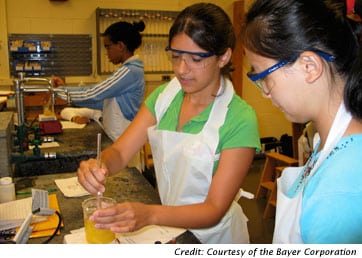
An overwhelming majority, 83 percent, of women and minority chemists and chemical engineers recently surveyed said a diverse work force is beneficial to their company’s success. Yet two-thirds of those scientists said their own workplace falls short of such diversity.
Comments from the March 2010 survey, conducted by the Bayer Corporation, headquartered in Pittsburgh, indicate that gender stereotypes often start early and never go away.
"Our society prescribes to this stereotypical behavior. Only girls can play with dolls and only boys can play with Legos," said a Caucasian female scientist in the survey.
"Entrance positions are not a problem. But after the first 10 years of your career, women and minorities start losing ground with their peers. Small disadvantages and biases accumulate over time," said an American Indian female chemistry professor.
The survey questioned 1,226 female and underrepresented minority members of the nonprofit American Chemical Society, based in Washington. For the past 14 years, Bayer studies have gauged science issues in the United States. (Bayer Corp. is a subsidiary of Bayer AG, based in Leverkusen, Germany.)
A Threat to U.S. Competitiveness
 Some other survey findings: 77 percent said significant numbers of women and minorities are missing from the U.S. science, technology, engineering and math work force today because they were not identified or encouraged early on. Nearly two-thirds believe that under-representation of women and minorities in those fields threatens the United States’ global competitiveness.
"I feel like I’ve been increasingly encouraged as the years have gone by, but I didn’t always feel as actively encouraged," said Julia Kubanek, associate professor of chemistry at Georgia Tech in Atlanta.
Like most scientists of all ages, genders and ethnic backgrounds, Kubanek was mesmerized by science as a kid.
"My friends were nerdy like me in high school. But I do remember peer influences about what girls should be," said Kubanek. Fortunately, she said, she had very supportive parents.
While some of her undergraduate classes were about a third women, others were 80 percent male. She earned her doctorate in organic chemistry from the University of British Columbia, Canada, in 1998.
Kubanek’s career, specializing in chemical ecology, has soared. In 2004, she was recognized with a Presidential Early Career Award for Scientists and Engineers, a top honor for research scientists.
But as an adviser to female graduate students, she still sees roadblocks during critical periods of their training.
"Female Ph.D.s really feel burned out," said Kubanek.
They often decide to get out of academics.
"I’ve heard them say, ‘I’m just going to take a job; just a job, so I can have a family and a life. I’ll gladly hand over the better opportunity to my spouse,’" said Kubanek. "They decide to do something more personally predictable, but less satisfying."
A Search for Solutions
Many government research grants that universities rely on don’t provide sick days or maternity leave. Kubanek has successfully worked with female grad students to find some solutions, such as other sources of funding so that women who need a short leave don’t have to quit the programs they are in.
Kubanek said some older male scientists still carry prejudice toward women, but that is harder to get away with.
"Male colleagues who exhibit hostility are increasingly isolated or marginalized. Their hostility is not accepted by the mainstream anymore," she said.
Mary Frank Fox has been working on issues of gender and science since 1993, also at Georgia Tech. Whether in an academic or corporate environment, she said there are plenty of ways to recruit, retain and promote women in science.
"If they want to make it happen, it can happen. It takes an organizational will and organizational means," said Fox, a sociology professor in the School of Public Policy and co-director of the Center for the Study of Women, Science and Technology.
Fox said the number of doctoral degrees awarded to women in physical sciences is improving. It was 15 percent from 1980-1989, 21 percent from 1990-1999 and 26 percent from 2000-2005.
"In degrees awarded to women at the highest level, there are indicators of notable progress," said Fox. Yet, the proportion of female full professors in those fields is still less than 7 percent.
Bales, who is now a vice president at NeuroPhage Pharmaceuticals, based in Cambridge, Mass., said that in the corporate world, equal opportunity is a mindset that must come from the top.
She spent 10 years as a senior director in regulatory affairs for Genentech, a pioneering company in biotechnology.
"When I was there they really went out of their way to make sure people were getting mentored," she said. Their policy, she added, was that it was not wise to tolerate sexism.
Would you like to Comment but not sure how? Visit our help page at https://womensenews.org/help-making-comments-womens-enews-stories.
Marsha Walton covers science, technology, environment and space issues. She was a producer for CNN’s science and tech unit for more than 10 years. Her work has also appeared on Mother Nature Network, Appalachian Voices, and the National Science Foundation.
For more information:
Bayer "Making Science Make Sense":
http://www.bayerus.com/msms/MSMS_Home.aspx
American Chemical Society:
http://portal.acs.org/portal/acs/corg/content