 GULU, Uganda (WOMENSENEWS)–After getting married at 18, Alice Ongom, who is now 45, settled down in Gulu, a northern Ugandan city that was a battleground during the country’s intermittent civil war from 1986 to 2003.
But after giving birth to five daughters, her in-laws worried she couldn’t give her husband a male heir.
"All my in-laws hated me and told my husband to chase me away," Ongom says. "He did not chase me away, but instead he brought in another woman."
After his second wife fell sick and Ongom lost three sets of twins, Ongom says she suspected that her co-wife was suffering from AIDS and that her husband had transmitted HIV from her co-wife to her. Ongom took an HIV test and found out she was HIV-positive.
Ongom says the problem started with her father, who was guided by traditions that place a premium on boys and discount girls.
"I should not have got married at 18 years," says Ongom, who dropped out of school in grade seven. "I should have been in school. My dad refused to pay school fees for all of my siblings because we were girls."
She says it’s a cycle.
"My mother had been accused of bearing only girls and chased from her matrimonial home," she says. "We grew up with our stepmother."
Uganda has one of the largest populations of people living with HIV/AIDS in the world, according to international data.
HIV Awareness Gender Gap
Education is one factor fueling a gender gap in HIV awareness in the country. Because of poverty and early pregnancy, just 7 percent of girls attend secondary school, according to the Ministry of Education. Only 32 percent of young women and 38 percent of young men in Uganda have comprehensive knowledge of HIV, according to UNICEF.
In northern Uganda the gender gap in HIV awareness is wider. Almost double the percentage of men and young men here had comprehensive knowledge of HIV/AIDS compared with their female counterparts, who do not receive much schooling and demonstrated less HIV/AIDS knowledge than most Ugandan women, according to the latest Uganda Demographic and Health Survey.
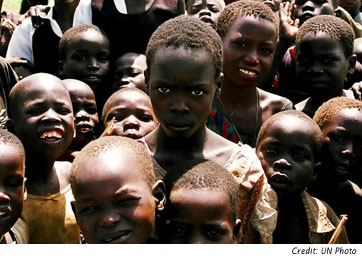
Northern Uganda has the country’s second-highest HIV/AIDS prevalence rate behind central Uganda, according to a 2008 report by the Program for Accessible Health, Communication and Education, a local organization. Authors attribute that to the 20-year insurgency in the region by the Lord’s Resistance Army starting in 1986. More than 1.6 million Ugandans fled their homes and about 30,000 children were abducted, according to the U.N.
The rebels terrorized anyone perceived to be sympathetic to the government by cutting off their body parts and forcing children to be soldiers or sex slaves, according to Human Rights Watch, the international human rights organization.
Insurgency Fuels High HIV Rate
"HIV prevalence in northern Uganda is higher than the national average because of the insurgency," says Dr. Zainabu Akol, manager of the AIDS Control Program, set up by the Ministry of Health. "People were made to live in camps, and sex became the only source of entertainment."
Water scarcity in internally displaced person camps also led to long lines and night trips to the wells or "boreholes," says Muzaaya Geofrey, manager of the Gulu branch of The AIDS Support Organization, TASO, a nongovernmental organization that provides HIV services.
"The more time they spend at the borehole, the more they get exposed to acts that expose them to HIV," he says.
Geofrey says that a lack of education and push toward early marriages by parents – and by women who wanted a man to protect them during the war – also led to a higher frequency of HIV transmission.
"Many children born during the war did not go to school," he says. "They are now adolescents. Parents are marrying them off to get favors or money."
AIDS Control Program’s Akol says there are many governmental and nongovernmental organizations working on HIV/AIDS in northern Uganda. Ongom says one of these, TASO, helped her cope with her diagnosis.
"Before I joined TASO, I had contemplated suicide," Ongom says. "I wanted to kill myself and poison my children because I had lost hope."
She says TASO has also provided free medication and counseling, which she says has helped her to stop hating herself.
Adapted from original content published by the Global Press Institute. Read the original article here. All shared content has been copyrighted by Global Press Institute.
Would you like to Comment but not sure how? Visit our help page at https://womensenews.org/help-making-comments-womens-enews-stories.
Would you like to Send Along a Link of This Story?
https://womensenews.org/story/hivaids/110422/wars-legacy-fuels-hiv-spread-in-northern-uganda
Apophia Agiresaasi joined Global Press Institute in February 2011. She has completed certified Global Press Institute trainings in gender and post-conflict reporting and arts and culture.