
.jpg) (WOMENSENEWS)–Dena Melin feels blessed to be breastfeeding–especially because of the state in which she lives.
(WOMENSENEWS)–Dena Melin feels blessed to be breastfeeding–especially because of the state in which she lives.
"Here in California, doctors handed me both my babies immediately after birth, so both were nursing within 20 minutes of delivery," said Melin, 40, a stay-at-home mom in Atwater. "Lactation consultants came to my home to help with my infant daughter just as they once helped with my three-year-old son. And I feel confident breastfeeding in public because I see plenty of other women doing it, too."
This month, which is National Breastfeeding Awareness Month, lactation advocates in California have special reason to celebrate, as Melin’s story isn’t a rarity in the state.
"In most studies on breastfeeding, California continually comes out on top," said Dr. Ruth Lawrence, chair of the section on breastfeeding for the American Academy of Pediatrics, based in Elk Grove Village, Ill.
The latest such study is a March report from the Atlanta-based Centers for Disease Control and Prevention, known as the CDC. It indicates that in California, women of all races are significantly more likely than mothers in other states to try breastfeeding and to continue until their infants’ sixth month of life–a practice recommended by health authorities.
The higher rates are not by accident or a product of geography. Compared to other states, California has longer-standing and stronger laws that protect a woman’s right to nurse in public and to express breast milk on the job, as well as more hospitals that have been recognized for promoting breastfeeding among patients.
Still, California activists are working to strengthen laws, to create more equitable breastfeeding outcomes across racial and socioeconomic lines and to improve hospital services even more.
Room for Improvement
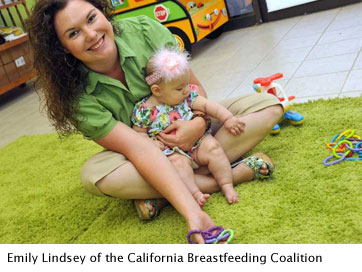
"Our numbers may be better than those in other states, but there’s always room for improvement," said Emily Lindsey, a spokesperson for the California Breastfeeding Coalition, based in Sacramento. The coalition serves as an umbrella organization for 43 smaller coalitions across the state.
Studies indicate exclusive breastfeeding until the six-month mark significantly reduces children’s risk of asthma, allergies, diabetes, obesity and gastrointestinal and respiratory tract infections. It also protects mothers’ health by slashing their risk of diabetes and ovarian and breast cancers.
California activists have been touting these benefits for decades. The state jumped on board in the late 1980s, when government agencies began offering breastfeeding support and breast pumps. One agency to make this change was Medi-Cal, California’s state-run Medicaid program. Another was California’s branch of the Special Supplemental Nutrition Program for Women, Infants and Children, also known as WIC. This federal initiative provides nutritional counseling and food supplements to low-income women and their children. It serves 60 percent of California’s infants.
In 1996, the state’s Department of Health Services issued a landmark report on breastfeeding, with new recommendations that led to further changes. In 1997, California became one of the first states to legalize breastfeeding in public, which is now allowed in 43 other states. In 2001, it required all employers to provide a private, sanitary place for mothers to pump breast milk and a "reasonable" amount of break time for them to do so. Similar legislation is now in force in 23 other states and is part of federal law as well.
Alongside these changes came what many consider to be California’s crowning achievement: improved breastfeeding practices in its hospitals. Maternity ward supervisors began offering lactation training to staff members. Nurses began helping new mothers breastfeed right after birth. And hospitals began hanging blue-and-pink posters of breastfeeding mothers on their white waiting room walls.
Highest Number of Hospitals
 As a result of these improvements, California now boasts the country’s highest number–and highest percentage–of hospitals that are Baby-Friendly, a designation birthing facilities can win if they successfully promote breastfeeding among their patients. Facilities must meet rigorous standards set by the World Health Organization and the United Nations to receive this designation, such as not accepting any financial support or product donations from formula companies; keeping mothers and infants together in the same room after delivery; and giving newborns no formula unless doctors deem this medically necessary.
Of the 96 Baby-Friendly facilities in the United States, 30 are located in California. And among the five hospitals most recently designated, four are in the state.
As such victories are celebrated, California health advocates are also setting their sights on new goals.
One is to achieve greater racial parity in lactation outcomes. Breastfeeding rates are better in California than they are on average in the United States, with 85 percent of mothers in the state initiating breastfeeding (compared to 74 percent overall) and 53 percent breastfeeding at the six-month mark (compared to 43 percent overall), according to the CDC.
Even so, in California, as is true in the rest of the country, breastfeeding rates among Hispanic and African American women lag behind those of the state’s white women. The recent CDC report indicated that in California, 86 percent of white women try breastfeeding and 61 percent continue it for six months. Among Hispanic mothers, 85 percent start breastfeeding and 51 percent continue, while among black women, 67 percent initiate lactation and 29 percent continue.
Health advocates say rates are also divided along socioeconomic lines, and are significantly lower among women with lower incomes.
Achieving More Balance
To bring these numbers into balance, California breastfeeding advocates have launched a variety of initiatives.
"We’re reaching out to low-income communities and speaking at black churches," said Lindsey. "We’re translating pamphlets into Spanish and working to hire more lactation consultants who are women of color."
In 2009, California’s WIC program helped achieve better racial and socioeconomic balance by requesting and securing a six-fold increase in funding for its peer counseling program, which trains women who are WIC recipients to teach other women how to breastfeed.
"In a single year, we’ve increased our number of peer counseling sites from 15 to 53," said Laurie True, executive director of the California WIC Association. "Many sites are headed by black and Latina women, and they are receiving the most advanced training and certification possible."
Breastfeeding advocates’ second aim is to improve services in hospitals that still lag behind. A 2008 University of California, Davis study found that in some California hospitals, formula is still given to 90 percent of newborns. And although 87 percent of California mothers initiate breastfeeding, only 42 percent are still breastfeeding exclusively by the time they are discharged from the hospital after delivery.
In response, Los Angeles County recently offered increased funding to hospitals that succeed in winning Baby-Friendly status and the California WIC Association has warned its clients to steer clear of hospitals known for having substandard practices.
Health advocates also hope to strengthen California’s breastfeeding laws even more.
"Within the next year, we may also introduce a bill that would require all California hospitals receiving state funding to attain Baby-Friendly designation," said True. "This hasn’t been done in any other state. But in California, we’re trying to pave the way and to set the highest standards possible."
Would you like to Comment but not sure how? Visit our help page at https://womensenews.org/help-making-comments-womens-enews-stories.
Molly M. Ginty (http://mollymaureenginty.wordpress.com) is a freelance writer based in New York City.
For more information:
California Breastfeeding Coalition:
http://www.californiabreastfeeding.org/