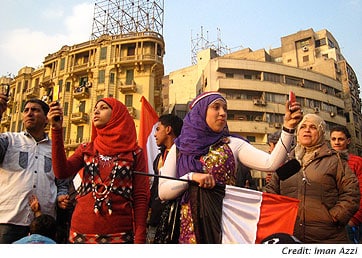
 CAIRO, Egypt (WOMENSENEWS)–On Sunday, Feb. 13–just 48 hours after the resignation of Hosni Mubarak as president of Egypt in response to 18 days of street demonstrations–physician, novelist and former political prisoner Nawal El Saadawi welcomed 12 other women’s rights activists into her Cairo apartment.
They joined to celebrate and look forward and backward.
“We need to guarantee that there is no abortion of the revolution,” she told Women’s eNews, adding that she had already been in touch with women and men as to how to proceed in this new Egypt. “I have confidence in the revolution. I am optimistic by nature. I believe in the collective power of women and men.”
Saadawi and her allies wasted no time in planning to revive the Egyptian Women’s Union, an organization banned under Mubarak’s regime after first lady Suzanne Mubarak, widely celebrated internationally for her humanitarian work, consolidated control over women’s issues throughout Egypt.
Author of over 15 books on gender and the Middle East, Saadawi wants to make sure women are not pushed aside in post-Mubarak Egypt.
The meeting, organized at the last minute, was to make sure that women’s voices–loud and listened to both at Egyptian rallies, in the media and popular blogs, Facebook and Twitter–do not go unnoticed in the transition period, while the country is under military control and until a constitution is reformed and a new parliament and president are elected.
Beige tanks and soldiers manned several corners around Cairo, but otherwise, just days after the protester’s victory against Mubarak, life on the streets looked remarkably similar to the days before the protests, which took the lives of 300 Egyptians and injured thousands.
One of Saadawi’s immediate priorities is to keep Egypt from developing any resemblance to post-revolutionary Algeria.
‘We Learned a Lesson’
“We learned a lesson from Algeria. We saw that when men take over, women’s rights are ignored. We have to claim our space today,” Saadawi said.
During Algeria’s 1954-62 war for independence against France, women played roles as combatants, bombers, spies, nurses and communication officers.
But after the French left, revolutionary slogans about equality dissipated and women were pushed back into submissive roles. Islamic groups linked women’s rights to Western cultures and discouraged legal reforms. Women’s participation in the work force dropped.
The Iranian revolution tells a similar story.
In 1979, thousands of women in Iran protested the regime of the Shah, only to see the demonstrations usher in the start of Islamic rule and limitations on several of their freedoms.
Despite rallying cries of “liberty” and “independence,” when Ayatollah Khomeini returned from exile he prioritized ridding Iran of secular laws, including the Family Protection Law, which denied husbands the right to automatic custody of the children and the right to unilateral divorce. Women were required to wear the veil. Violent punishments for violating dress code and adultery were imposed.
But Egypt is not a colony fighting for independence nor was this an Islamic revolution. This uprising was driven by a notably non-ideological populace protesting a generally oppressive regime.
Saadawi is quick to point out that it was not just men who stalled the Egyptian women’s movement but also the ousted first lady, Suzanne Mubarak, who consolidated women’s activism under the umbrella organization, the National Council for Women, which she controlled. Women’s groups could register independently, but work often had to be approved by the ministry and activists felt uneasy about the first lady’s leadership role.
“Suzanne Mubarak killed the feminist movement so she could be the leader,” Saadawi told Women’s eNews.
‘Almost Nothing on Women’
 Hoda Badran is chairperson for the Alliance for Arab Women, a Cairo-based organization that has operated throughout Egypt since 1987 to educate and train women on their rights and to push Egypt to follow the global plan for women’s rights laid out in the U.N. Fourth World Conference on Women in Beijing in 1995.
From the early 1980s to 1995 there was “almost nothing on women,” Badran said in an interview held in her Cairo office. “Then in 1995, there was Beijing and Suzanne Mubarak came back almost, not really, but almost, ashamed of where Egypt was in terms of gender rights.”
Badran initially joined the board for the National Council for Women, but was slowly pushed out in the first three years with 10 other activists she says were seen as too critical, too radical. While over the years Suzanne Mubarak raised the profile for women and children in Egypt, critics like Badran and Saadawi believe she did not do enough to tackle controversial issues or provide a space where women’s rights could be actively debated.
“Under Mubarak, everything was going backwards, including women’s rights. There was always unfinished business. Whatever has been done has been little by little and left unfinished, incomplete,” Badran said.
As an example, Badran points to how Mubarak reformed the nationality law to allow Egyptian women to pass on Egyptian citizenship to their children. But the law stopped short of enabling women to pass on citizenship to foreign husbands or to any woman who has children with a Palestinian or a Sudanese man and was not made retroactive for children born before the law’s passage in 2004.
Prioritizing Literacy
Badran and her staff at the Alliance for Arabic Women are prioritizing a literacy campaign in coming months.
A third of Egypt is illiterate, while some estimate that the percentage of women who cannot read is over 40 percent.
While the Internet–especially Facebook and Twitter–has been praised for its unifying role in the protests, millions of Egyptians cannot access the Web. And it is these Egyptians Badran wants her group to focus on in the coming years, with hopes to eradicate illiteracy by 2013 as they join forces with a coalition of nongovernmental organizations to recruit volunteers to teach others to read.
A longer-term goal for Badran is to establish public nurseries and more support systems for women working outside the home.
Egyptian women’s lack of understanding of their rights and a possible rise in conservative Islamic views about women’s social roles are other challenges Badran sees ahead.
Fifty-four percent of Egyptians favor the legalization of gender segregation in the workplace law, the highest level after Pakistan in a poll of seven Muslim-majority countries conducted in the spring of 2010 by the Washington, D.C.-based Pew Research Center.
The Inclusion of Men
Both Badran and Saadawi stress the inclusion of men as activists as well as men as recipients of their projects and educational work.
“I think about what happened in Algeria,” Badran said. “To stop this, we have to demand our rights. I myself am optimistic but we cannot just sit around and do nothing.”
Badran’s office is only six blocks away from Liberation Square.
On Monday, those streets were filled both with citizens still celebrating and those shopping for sweets for Tuesday’s holiday, Prophet Muhammad’s birthday; others continued to clean up the streets, paint new street markings or scrub off graffiti.
Aisha Bassyouny, 24, spent the first weekend after the revolution like thousands of Egyptians–sweeping streets and picking up trash with several of her friends.
“We saw the initiative on Facebook to come to Tahrir [Liberation] Square to clean, but when we started walking people we met told us there were so many people already there that we decided to clean up here,” Bassyouny said, standing in a small park in front of Cairo’s Mustapha Mahmoud Square, the scene of one of the larger pro-Mubarak rallies. “Yes, Mubarak” graffiti still covered billboards and shop fronts in the area.
“The revolution is over but hopefully it will evolve and never really be over. We have so much to do,” Bassyouny said, before walking over to continue sweeping the brick path with her friends.
Would you like to Comment but not sure how? Visit our help page at https://womensenews.org/help-making-comments-womens-enews-stories.
Would you like to Send Along a Link of This Story?
https://womensenews.org/story/the-world/110216/cairo-leaders-suzanne-mubarak-held-women-back
Iman Azzi is a freelance journalist based in Beirut, Lebanon.
For more information:
Nawal El Saadawi’s Web site:
http://www.nawalsaadawi.net/
“Muslim Publics Divided on Hamas and Hezbollah,” Pew Research Center:
http://pewglobal.org/2010/12/02/muslims-around-the-world-divided-on-hamas-and-hezbollah/
“The Women’s Movement” by Haleh Esfandiari:
http://iranprimer.usip.org/resource/womens-movement