
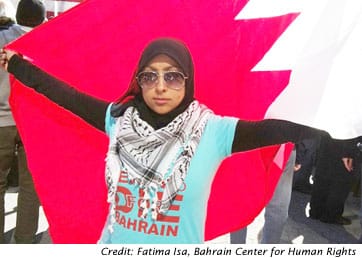
 (WOMENSENEWS)–Ayat al-Gormez, Maryam al-Khawaja, Lamees Dhaif, Amira al-Husseini.
These are just four of the young women who are giving their names, faces and voices to the revolutionary effort in Bahrain.
The most famous example is al-Gormez, a 20-year-old poet who got up on the makeshift stage in Pearl Square in Manama–the nerve center of the demonstrations–and read her poem about a conversation between King Hamad bin Issa Al-Khalifa and Satan.
She became a YouTube sensation, but was arrested in June and sentenced to a year in prison. On July 13 she was unexpectedly released; she had reported to have been tortured while in custody. While the regime may have silenced her temporarily, al-Gormez remains a significant revolutionary figure.
“One of the things I love about the Bahraini revolution is that you have a female who became a symbol for the revolution, and it’s not only the girls that look up to her, it’s the men as well,” said Maryam al-Khawaja, director of international advocacy for the Bahrain Human Rights Center, a Bahrain-based nonprofit. “I love the fact that all my guy friends were talking about how much they look up to her and how she was like the icon of bravery to them.”
Bahrainis under the age of 30 make up 65 percent of the population and the preponderance of demonstrators. As men and boys were rounded up and arrested by the hundreds in the first waves of demonstrations in February, such young women have emerged more visibly, maintaining a cause that has left several peaceful protesters dead from police violence.
Al-Khawaja Tweets Protests
One of the most prominent online activists is the Bahrain Human Rights Center’s al-Khawaja, the 24-year-old daughter of a leading human rights activist.
Before the massive Feb. 14 protests she was not much of a Twitter user and had only about 30 followers. Now she has 19,000 followers and has sent more than 5,000 tweets, providing real-time coverage of various protests overlooked by many formal news agencies. As demonstrators flooded the streets she stayed for days on end in Manama’s Pearl Square Roundabout tweeting round the clock.
On March 18 the government destroyed the famous statue at the center of Pearl Square Roundabout–the one featured on its currency–in an effort to silence its citizens.
Bahrain is a relatively wealthy country and Internet connections and smart phones are widespread. Al-Khawaja and others are using their keyboards and mobile phones to oppose what they see as two major forces of silence.
One is the mainstream Arab media, largely aligned with media powerhouse Saudi Arabia, the Sunni-ruled ally of Bahrain. Saudi media entities control about 70 percent of the regional advertising market and that professional influence has helped muffle attention to the uprising in the region.
Another silencer is the United States, which has largely withheld criticism from Bahrain, a regional ally that hosts the U.S. Fifth Fleet.
Al-Khawaja says Bahraini authorities frequently hack into e-mail accounts and disrupt online critics. That day her Twitter account had been hacked, blocking access to her account.
“I feel like my life is empty!” she half-joked.
In March she left Bahrain for the United Nations Human Rights Council in Geneva to take part in a panel discussion about the human rights abuses occurring in her country. Since then she has been unable to return to Bahrain and spends her time traversing the globe, raising awareness and advocating for human rights in Bahrain.
Sister Leads Protests
 Her sister Zainab, better know by her AngryArabiya Twitter handle, remains in Bahrain, leading protests, such as the hunger strike against the arrests of her father, husband and brother-in-law, arrested as part of a roundup of human rights activists.
Al-Khawaja says that wherever she goes she is followed by pro-government minions who report back on her activities and do what they can to prevent her from making public appearances.
“They send like 600 e-mails to places I’m speaking telling them not to let me speak,” she said. But she brushes off her pro-government shadows. “I don’t really care; they’re not important enough to pay attention to. I have more important things to do.”
In May she gave a speech at Columbia University and congressional testimony about the serious human rights abuses occurring in Bahrain. She has countered Bahrain’s characterization of the protests as a primarily sectarian struggle against the Sunni-led government.
“According to the government of Bahrain, the protests were mainly Shia, but also there has been a targeting of Sunni people in these arrests and crackdowns,” she testified, adding that 1,176 had been arrested, with about 25 percent of them under age18.
“We have also heard several accounts in which female students 11 to 16 years old were arrested from schools,” she told members of the Tom Lantos Human Rights Committee.
Regime supporters have mounted their own online efforts to discredit dissent.
One sign of that are accusations of lying and traitorism sent via Twitter accounts. The government has also launched Facebook and Twitter pages to push people to make loyalty pledges online.
Several times a week al-Khawaja sends an e-mail update on the situation on the ground, gathering information from an extensive network of trusted sources in Bahrain. She systematically documents arrests and allegations of torture and death by providing links to videos on YouTube or other documentation.
Among the most egregious arrests are those of doctors who provided emergency care to protesters in the Pearl Roundabout. The crackdown on physicians, which began in April, has prompted activists and doctors to provide consultations via Skype, the Luxembourg-based company that provides low-cost telephone and video conferencing over the Internet.
“Because of the many protesters who are refusing to go to the hospital despite their injuries because of the fear of arrest, they’re trying to treat themselves at home,” said al-Khawaja. “They can directly call them [doctors] via Skype for medical advice.”
But of course fractures and broken bones are still difficult to treat at home, she says.
Family Members Arrested
Nahda Dhaif, a dental surgeon with two young children, was among the doctors arrested, and was reportedly tortured during nearly two months in prison. Her sister Lamees, a prominent and outspoken media personality and blogger, had grown increasingly critical of the Bahraini authorities and was warned to stop writing.
“I can stand for myself to be targeted, but not my sister,” Lamees Dhaif told Women’s eNews while in Washington, D.C., as part of a State Department international visitor program. She said that even though she stopped writing her sister was tortured, so she decided she could no longer remain silent.
Lamees Dhaif has lost her livelihood. Her home was attacked with a Molotov cocktail and she was targeted in a government smear campaign that included a Facebook videogame with her as one of the targets. She decided the only way to try to protect herself and her family was to resume speaking out.
“Even the dead will tell their stories,” she vowed.
Eventually, she fled Bahrain for Dubai, where she has been unable to find a journalism job because of what she believes is pressure from Bahrain on Arab news outlets.
Her blog is now her main form of communication. She often posts lyrical moral stories about peaceful protesters and argues for more political awareness to combat corruption. Her reflections on the political upheaval include pleas for sanity and prayers for peace.
“God save Bahrain and its people from hatred,” she wrote in one recent post deploring the violence meted out to innocent protesters.
The regime also has sought to silence its critics by threatening, firing and arresting journalists and bloggers. A censorial pall has driven many from the country.
One of them is Amira al-Husseini, a prolific blogger and Middle East editor of Global Voices Online, a blog aggregator that has played a significant role in curating the “Arab Spring” revolutions. Al-Husseini was among the first generation of Arab bloggers and is a copious tweeter. Her blog, Silly Bahraini Girl, was blocked in Bahrain earlier this year.
“What laws and regulations have I violated for my blog to be blocked? And how exactly can you block me? How do you intend to silence me?” she wrote in an angry post in early January. “You can stop my readers from accessing my posts in Bahrain, but how would you shield the rest of the world from seeing the truth as it is, without censorship and repression?”
Would you like to Comment but not sure how? Visit our help page at https://womensenews.org/help-making-comments-womens-enews-stories.
Would you like to Send Along a Link of This Story?
https://womensenews.org/story/leadership/110727/bahrains-young-women-keep-the-revolution-aloud
Courtney C. Radsch is a Middle East media expert and is currently the freedom of expression officer at Freedom House. She’s the author of hundreds of articles and book chapters and is turning her dissertation, “The Revolution will be Blogged: Cyberactivism in Egypt,” into a book. Follow her “at” courtneyr and on her blog http://www.radsch.info
For more information:
Lamees Dhaif’s blog:
http://www.lamees.org/
Amira al-Husseini’s blog, Silly Bahraini Girl:
http://sillybahrainigirl.blogspot.com/
Maryam al-Khawaja’s testimony before the Tom Lantos Human Rights Committee:
http://tlhrc.house.gov/docs/transcripts/2011-05-13_Bahrain/Transcript.pdf
YouTube video of Ayat Al-Qormezi–A Poem Worth a Year of Brutal Torture and Imprisonment:
http://www.youtube.com/watch?v=mcCEk9s82ac
Arab Media blog:
http://www.radsch.info/